Growth in SaaS is often talked about like it is a traffic problem. Teams are perpetually obsessed with booking more demos or increasing signups. Everyone is happy as long as the top of the funnel looks healthy.
But take a moment to zoom out. Look at the companies that actually scale in fintech and B2B SaaS, and you’ll find that the story is rather different. Their revenue grows because existing customers stay, expand, and deepen their usage over time. The numbers reflect that in metrics like net revenue retention, but the underlying driver is something more human.
It is trust.
When a company is selling analytics software, financial data, payments infrastructure, or any product that influences decisions involving money, the user is silently asking a simple question: “Can I rely on this?”
If the answer becomes yes, revenue follows. Users upgrade, teams add more seats, and procurement renews the contract without drama. The product slowly becomes part of the workflow rather than a tool that faces evaluation at the end of every quarter.
This is very evident in high-performing SaaS businesses that report net revenue retention above 100 percent. This expansion was not a result of marketing pushing beyond limits; it manifested as a result of the customer’s comfort in going deeper. It was about their willingness to integrate the product into their processes. It had to do with them being confident enough to depend on it.
The stakes are even higher in fintech. These products move money, calculate risk, surface signals, and influence real decisions. Trust sits at the very core of whether the product survives inside an organization.
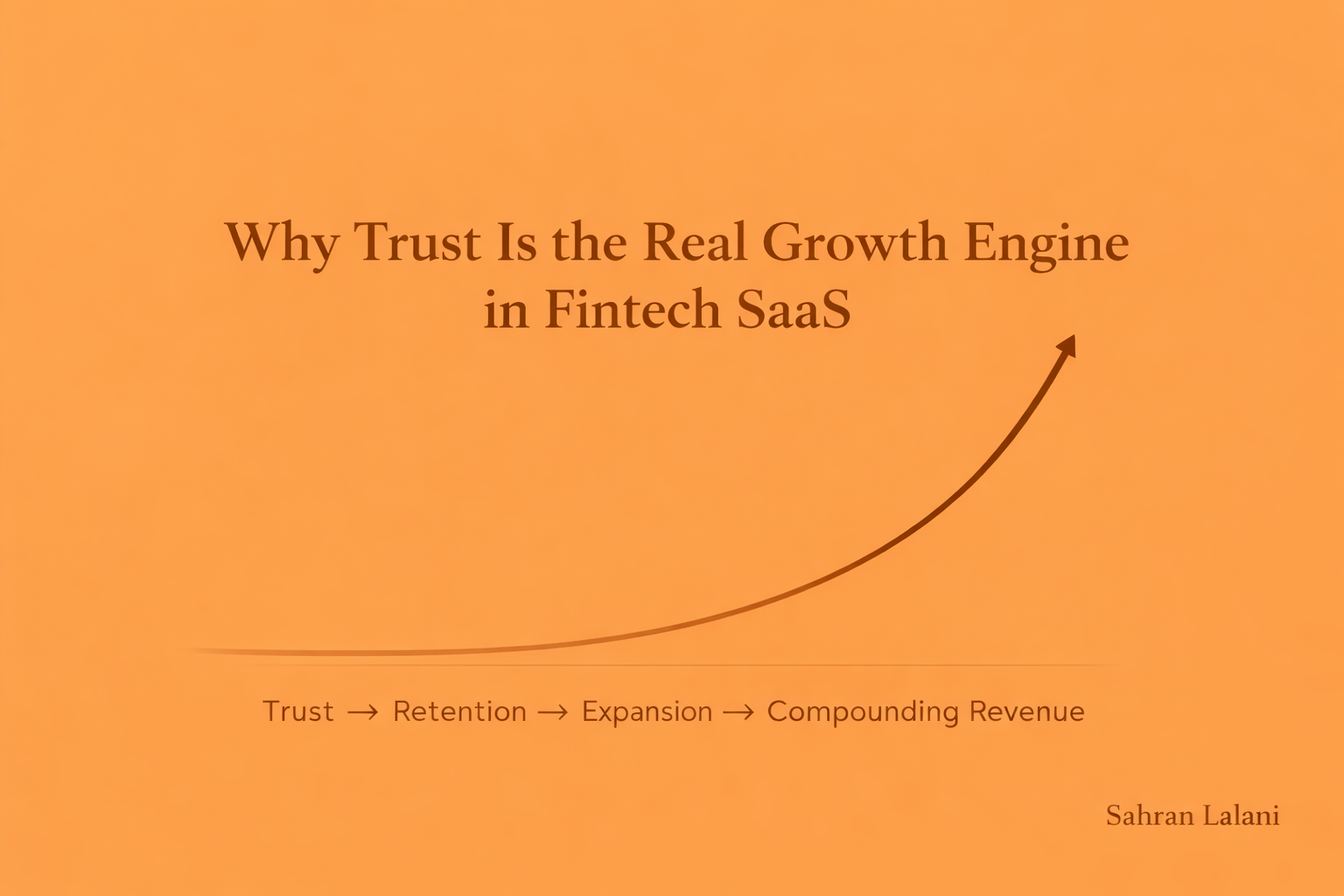
This is why I see trust as the real growth engine in fintech SaaS. Acquisition may start the relationship, but trust determines if it compounds.
In this piece, I want to unpack that idea in a practical way. We’ll look at how trust shows up in metrics like retention and expansion, how it is built operationally through product and customer success, and why it matters more in financial software than in almost any other category.
Trust Isn’t Abstract
It sounds a little soft when people talk about trust in business. It gets bundled into brand, reputation, or customer sentiment, and then parked somewhere in the marketing department.
In SaaS, and especially in fintech, trust is much easier to observe than that. It shows up in behavior. And behavior shows up in revenue. If a customer signs a one-year contract and then quietly leaves at renewal, that tells you something. If they renew, add more seats, upgrade to a higher tier, or expand usage across departments, that tells you something else entirely. Those are pragmatic decisions. Teams expand tools they believe are reliable, accurate, and safe to depend on.
This brings us to the very interesting concept of net revenue retention. When a company reports NRR above 100 percent, it means existing customers are spending more over time than they are churning away. On paper, it looks like a financial metric. But to me, it is more of a confidence metric.
Because customers won’t expand their spend on software that they are not sure about or on software that is unproven in real workflows.
In fintech, that proof can be even more specific. It might mean that the data has been consistently accurate, the platform has handled volume without outages, or that compliance and security checks have passed without friction during procurement reviews.
Ideally, it should mean all three.
Over time, trust reduces the mental tax of using a product. Users stop double-checking every output, and managers stop questioning every renewal. The product moves from “tool we are testing” to “system we rely on.”
And once that chasm is crossed, growth starts to look different. The importance of marketing does remain intact, but its role becomes more focused on continuity than on persuasion. Revenue grows because the product has earned its place.
That is why I see trust as a structural driver of SaaS economics. If you want to understand whether growth will compound, you can look at the revenue curves. Behind those curves, you will usually find a steady accumulation of trust.
How Trust Gets Built Inside a SaaS Business
If trust shows up in retention and expansion, the next question is obvious.
How does a company actually build it?
It is not the result of a single campaign or a clever piece of messaging. In most strong SaaS businesses, trust is the result of consistent operational decisions that reduce uncertainty for the customer over time.
Product reliability creates confidence
One of the biggest levers is product reliability. When a tool behaves predictably, loads quickly, produces accurate outputs, and handles edge cases without drama, users begin to relax. They no longer have to treat it as something that needs constant supervision.
This is even more crucial in fintech because the outputs influence financial decisions. If the numbers are wrong, or even slightly confusing, the damage affects real outcomes. Over time, reliable performance becomes a signal that the product can be depended on.
Customer Success Turns Usage Into Belief
Customer success plays a more subtle but equally important role. Good onboarding shortens the distance between “we bought this” and “this is helping us. Confidence builds when teams understand how to extract early value out of the product.
Responsive and informed support prevents small issues from evolving into doubts about the entire platform. Gradually, that steady reinforcement creates a sense that the vendor is a partner rather than just a software provider – and it is this change that then enables renewals to feel routine.
Transparency Reduces Friction
Transparency builds trust in subtle ways. Clear pricing reduces anxiety during renewal conversations. Public roadmaps show that the company is thinking ahead.
Honest communication during outages or incidents, while uncomfortable in the moment, often strengthens long-term credibility.
Customers can tolerate problems, but not uncertainty – uncertainty that can be mitigated through open and steady communication.
Security and Compliance Form the Trust Infrastructure
Security and compliance are infrastructure in fintech. Certifications, audits, and documented controls do not excite end users, yet they remove friction during procurement and legal review.
A product that can comfortably clear those hurdles, signals maturity. That maturity translates into larger contracts and longer commitments.
Why Fintech Raises the Stakes
All SaaS depends on trust to some degree, but fintech raises the stakes in a way that changes the entire growth dynamic.
When you are selling project management software or a design tool, the downside of failure is usually inconvenience. A workflow slows down or a team gets frustrated. Obviously, those problems are important, but not significant enough to threaten the customer’s financial stability.
Fintech products operate closer to risk. They influence capital allocation, move money, calculate exposure, surface trading signals, or inform reporting. The consequences of something breaking are far heavier.
That changes how buyers evaluate the product from day one.
In this environment, trust is not built only through brand storytelling. It is built through accuracy, uptime, documentation, and governance. Procurement teams look at security posture. Legal teams review compliance. Finance leaders ask how the data is sourced and validated. Even if the end user loves the interface, the organization still needs to feel comfortable placing real financial weight on the system.
This directly affects growth. In fintech, expansion revenue usually follows a period of proof. A team might start with a limited rollout. Then, if the outputs remain reliable and the system integrates cleanly into existing workflows, usage expands. More departments adopt it. Higher tiers unlock additional capabilities. Over time, the product becomes embedded in reporting cycles or decision-making processes.
And it is at that point of embedding that switching costs go up. The product has now earned a place in the organization’s financial nervous system.
This is also why volatility tests fintech trust so clearly. During market swings, outages, or regulatory changes, customers watch closely. If the platform remains stable and communicative, confidence strengthens. If it wavers, doubts are quick to compound. The same event can either deepen trust or erode it, depending on how the company handles it.
How Trust Turns Into Compounding Revenue
At this point, it helps to connect the dots directly between trust and the shape of the revenue curve.
Growth in SaaS looks smooth from the outside, denoted by a steady rise in recurring revenue and expanding annual contracts. Behind that curve, though, there is usually a gradual accumulation of customer confidence.
When a customer first signs, the relationship is still conditional. The team is evaluating the product. They are comparing it, sometimes silently, to whatever system it replaced. Revenue at this stage is fragile.
As months pass and the product consistently delivers, things start changing. Users stop double-checking every number, and managers begin planning around the tool rather than around workarounds. The software becomes part of the operating rhythm. That change may seem subtle, but is financially significant.
Expansion becomes easier once a product becomes embedded in workflows. Higher tiers feel justified because the incremental value is clear. Renewals turn into little more than administrative steps.
This is the start of compounding. Each year of retained revenue becomes the base for the next year’s expansion. Instead of resetting to zero and fighting for new logos to sustain growth, the company builds on a stable foundation of customers who already believe in the product.
Net revenue retention captures this dynamic numerically. When it rises above 100 percent, it signals that the base is not just stable but expanding. That expansion is the result of accumulated trust translating into deeper usage.
In fintech, this compounding effect can be even stronger because integration tends to run deeper than in many other categories of software.
Strategic Playbook – How to Drive Trust in SaaS & Fintech
If trust drives retention and expansion, then the practical question becomes simple. What should a company actually do differently?
Well, for starters, you need to align the way your business measures success and how it operates day to day.
Focus on Expansion Metrics
If you want to build trust, start by measuring the outcomes that trust influences.
Net revenue retention is one of the clearest signals. When it moves upward, it usually means customers are not just staying but growing. Logo retention tells you whether customers are quietly leaving after the honeymoon phase. Engagement and usage patterns show whether the product is becoming part of real workflows or sitting idle after onboarding.
If the leadership conversation revolve only around new pipeline, it is no surprise that organization naturally optimizes for acquisition energy. Treat expansion metrics as first-class signals, and your team will start to ask better questions.
Questions like: Why are customers upgrading? Why are some accounts stagnant? Where does usage drop off after month six?
This shifts attention from short-term wins to long-term confidence.
Invest in Customer Success as a Revenue Function
Customer success should not be treated as a support desk that reacts to tickets. In fintech SaaS especially, it is a core growth function.
Onboarding sets the tone. If the first experience feels confusing or incomplete, doubt creeps in early. When onboarding is thoughtful and structured, customers reach their first meaningful outcome faster. That early clarity reduces the emotional distance between purchase and value.
Proactive support also matters. Regular check-ins, usage reviews, and value delivery conversations remind customers why they chose the product in the first place. These are not just courtesy calls, but moments where the company reinforces reliability and alignment with the customer’s goals.
Integrate customer success with product and revenue teams, and you create a feedback loop that strengthens trust continuously.
Build Transparency Into the Operating Model
Transparency reduces friction in ways that are easy to underestimate.
Clear pricing architecture removes uncertainty during renewal conversations. If customers understand how costs scale and why, expansion feels rational. Public product roadmaps show that the company is thinking ahead and investing in the future. Even if every feature is not delivered exactly on schedule, visibility builds confidence.
Performance commitments, such as uptime targets or service level agreements, also shape perception. They signal that the company is willing to stand behind its promises.
In fintech, where decisions often pass through multiple stakeholders, transparency makes it easier for internal champions to advocate for the product. It gives them language and documentation they can share confidently.
Operationalize Security, Don’t Just Advertise It
Security and compliance cannot sit only in a sales deck. They need to be embedded in how the company operates.
Certifications and third-party audits send an external signal of discipline. They show that controls are reviewed and validated beyond internal claims. Clear documentation around data handling, sourcing, and governance helps buyers understand what sits behind the interface.
Public incident communication is another overlooked lever. Trust erodes quickly when something goes wrong. Transparent updates, clear explanations, and visible remediation efforts can actually strengthen long-term credibility. Customers may not expect perfection, but they do want accountability.
In fintech SaaS, operational maturity becomes part of the product itself. Security posture, governance standards, and communication discipline all shape whether customers feel safe expanding their reliance on the platform.
Common Misconceptions (and Why They’re Wrong)
In the world of SaaS and fintech, “trust” is often reduced to a buzzword, oversimplified in ways that obscure how sustainable growth actually functions. While several industry standard beliefs sound logical, they often fail to capture the mechanics of durable revenue.
1) “Growth equals acquisition”
It is tempting to equate growth strictly with “new logos.” When pipeline becomes the headline metric, planning meetings inevitably revolve around top-of-funnel volume and conversion rates.
While acquisition is the engine’s spark, it isn’t the fuel. In fintech, revenue is fragile if a customer churns after the initial contract or stalls at a pilot tier. True growth is a compounding interest problem. It stems from customers who deepen their reliance on the tool. When trust moves from the procurement office to the end-user’s daily workflow, acquisition stops being a treadmill and starts becoming a foundation.
2) “NPS is enough”
Net Promoter Score (NPS) offers a directional pulse on sentiment, but sentiment is a poor proxy for economic behavior.
In fintech especially, a “satisfied” survey response is often a mask for cautious stagnation. A customer may enjoy your UI but quietly refuse to integrate your API into their core stack.
Expansion and retention are the only honest metrics for trust. Revenue behavior tells the story surveys can’t: Are they adding seats? Are they upgrading tiers? If the money isn’t moving upward, the “satisfaction” is superficial.
“compliance is trust”
Certifications, SOC2 reports, and audits are the “table stakes” of fintech. They satisfy legal requirements and mitigate institutional risk, allowing you to pass through the gates of procurement.
However, compliance is not confidence. A platform can be perfectly audited and still feel unreliable. If the data outputs require manual verification, the interface is opaque, or support goes silent during a downtime event, trust erodes regardless of your certifications.
Trust in fintech has two layers. One is institutional, supported by compliance and security controls. The other is experiential, shaped by accuracy, usability, and responsiveness. The first allows a product to enter the conversation. The second determines whether it becomes embedded and expanded.
Conclusion: The kind of growth worth building
When you step back and look at the companies that endure in fintech and SaaS, a pattern emerges. Their growth doesn’t feel volatile or theatrical. Rather, it feels steady, measured, and reinforced by something deeper than marketing momentum.
Trust is often treated as a “soft” concept. Something reserved for brand campaigns or mission statements. In reality, it is a hard economic driver. You can see it in retention rates, expansion revenue, and the ease with which contracts renew. It manifests in the confidence of internal champions who are willing to stake their professional reputation on your product.
When customers trust a platform, they build around it. They weave it into their core workflows and introduce it to new teams. They rely on it during the moments that actually matter. That reliance transforms a simple vendor relationship into expansion revenue, and creates a stable base for future growth.
This distinction is even more critical in fintech. Software that touches financial decisions cannot survive on attention alone – it lives and dies on credibility. Without it, revenue remains exposed. A few inaccurate outputs or opaque communication during a high-pressure event can destabilize an account overnight.
Revenue without trust is fragile. It looks impressive on a dashboard, but it is unstable underneath. Revenue built on trust, on the other hand, renews, expands, and compounds.
And that is the kind of growth worth building.
About Sahran Lalani
Sahran Lalani is a SaaS and fintech growth strategist focused on retention, lifecycle marketing, and trust-driven revenue expansion. He works with companies building data, analytics, and financial software products.
→ Visit https://iamsahran.com
Leave a Reply