The “busywork” trap is the most expensive mistake a SaaS team can make.
On the surface, everything looks like a high-growth success story. The dev team is shipping features, marketing is A/B testing ad copy, and the SEO team is chasing keywords.
The dashboards are moving, the Slack channels are buzzing, and everyone is exhausted.
Yet, the revenue line is a flat horizontal.
This is the SaaS version of spinning your wheels in the mud. You’re revving the engine, but you aren’t moving an inch.
Growth hardly ever stalls across the board. It’s almost always a single, silent choke point that’s throttling the entire system. And because that bottleneck exists, every other win appears underwhelming.
Your world-class onboarding won’t matter if your pricing model is scaring people off. Your perfect ads won’t move the needle if the product-market fit has shifted.
And teams usually counter this by pushing harder on everything at once. They add more features, up their ad budget, and increase the number of emails they are sending out every week.
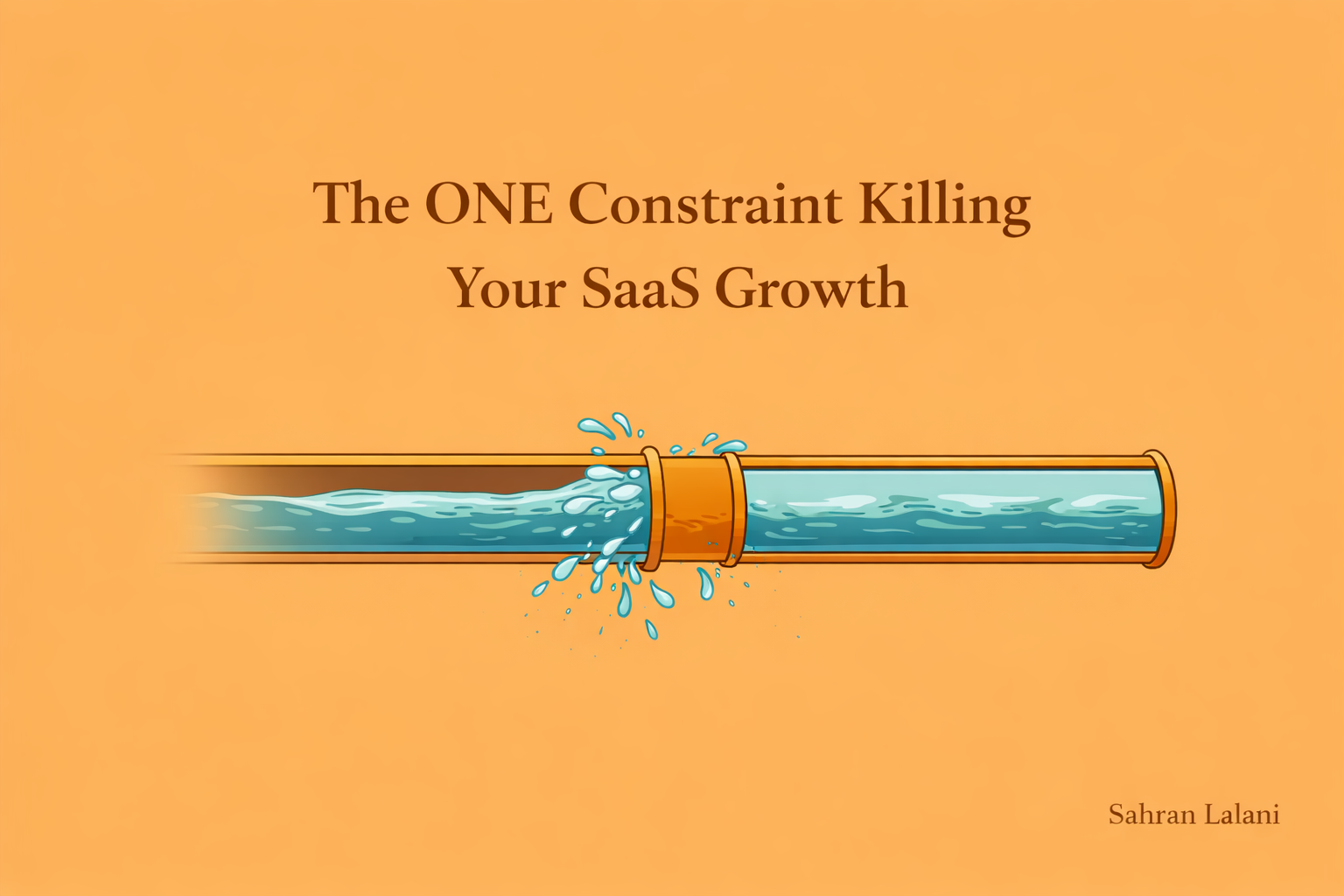
But adding more water to a pipe with a cap on the end just increases pressure until something bursts.
Identifying the “Single Point of Failure” in a growth engine requires looking at the system as a machine.
Why Most Teams Misdiagnose Growth Problems
There’s no loud bang when growth breaks. It’s a whisper that sounds like a hundred different tiny problems.
When one part of your system hits a ceiling, it creates a “halo effect” of failure. Everything downstream starts looking weak, inefficient, and broken. You start blaming the people in charge of those departments, but they’re just trying to process bad inputs.
The system fails at one point, and shows symptoms everywhere else.
The Illusion of Multiple Failures
We tend to solve the “pain” instead of the “problem.”
This is how it plays out in the wild:
- The traffic delusion: You double your SEO and ad spend, but revenue stays flat. You fire the agency for a “content problem.” In reality, you have an activation problem – you are inviting people into your house without unlocking the front door.
- The “UX” Mirage: You overhaul the onboarding flow, but there’s zero lift in retention. You blame a “UX problem.” All of this masks an acquisition problem — you’re perfectly onboarding the wrong type of user who was never going to stay anyway.
- The “Feature” Trap: You ship three major updates, but conversion doesn’t budge. You assume it’s a “product problem” and build more. What you actually have is a positioning problem —nobody knows why they should care about what you’ve already built.
Symptoms are Lying to You
If you have a blockage at the top of the funnel, your sales team looks incompetent. If you have a churn problem at the bottom, your marketing looks expensive.
You are treating the symptoms with ‘parallel activity’ because it gives the illusion of momentum. But until you find the single choke point, every other “improvement” is just a distraction.
The Single Constraint Principle
Teams treat growth like a checklist. They think if they do “enough” things, the numbers will eventually move.
But that is not the way systems work.
In any growth engine, there is always one primary constraint. It is the single bottleneck that dictates the speed of the entire company. And until you identify and resolve that specific point, every other “improvement” you make is just a waste of time and capital.
Growth has to do with removing the one thing that is stopping everything else from working.
The Law of Diminishing Effort
If your onboarding is broken, doubling your ad budget doesn’t double your revenue. It just doubles the amount of money you’re throwing into the toilet.
You’re working 2x harder for a 0.1x return.
Your ‘wins’ won’t compound if you’re focused on the wrong areas. They just sit there, isolated and ineffective.
You might have a world-class sales team, but if the product doesn’t solve a burning pain point, they’re just world-class at getting “no” for an answer.
Find the One, Ignore the Rest
The hardest part of this system is not even finding the bottleneck. It is to have the discipline to ignore everything else that is staring you in the face.
It feels counter-intuitive to stop “optimizing” your social media or “tweaking” your UI. But unless they’re the primary constraints, they are nothing else but distractions.
You need to be able to look at a messy dashboard and say, “None of this matters until we fix X.”
The goal is to move from a “Trial and Error” mindset to a “Diagnostic” mindset. Once the constraint is clear, the strategy becomes obvious.
Where Constraints Usually Hide
You are not growing because your system has a leak you haven’t plugged yet. To find your single constraint, you have to look at the four stages where SaaS engines typically seize up.
1. acquisition constraint
Here, the problem is not that you are not getting enough traffic, but also that you’re getting the wrong kind of traffic. You’re bidding on low-intent keywords or chasing viral vanity metrics that bring in “tourists” instead of buyers.
The Symptom: Your top-of-funnel numbers look great on a slide deck, but nobody moves to the next step.
The Reality: You’re filling the room with people who were never going to buy.
2. activation constraint
Users sign up, look around, and leave. Your “Time-to-Value” is bloated. If a user has to click fifteen times and watch a 5-minute demo just to see the “aha!” moment, you’ve already lost them.
The Symptom: Sign-ups are climbing, but your “Daily Active Users” (DAU) is a graveyard.
The Reality: You aren’t giving them a “win” fast enough to earn their attention.
3. Conversion constraint
This is the most frustrating one. They use the product, they clearly see the value, but they won’t pull out a credit card. Usually, this is a failure of positioning or a pricing model that feels like a tax rather than an investment.
The Symptom: You have a massive “Free Tier” or “Trial” user base, but your revenue is stagnant.
The Reality: Your CTA flow is clunky, or your price-to-value ratio is out of sync.
Retention Constraint
You’re working twice as hard just to stay in the same place. If you don’t have a habit loop or a lifecycle email system bringing people back, you’re in the “leaky bucket” business.
The Symptom: You hit your sales targets every month, but your total recurring revenue (MRR) barely budges.
The Reality: Your growth resets to zero every thirty days because your “back door” is wide open.
Only one of these is your real problem right now. The rest are distractions.
How to Identify Your Actual Constraint
Finding your bottleneck is about finding where the energy in your system hits a wall. Teams fail because they mistake ‘activity’ for ‘progress’.
This is how you can audit your engine without getting distracted by the noise:
Step 1: Find where momentum dies
Every funnel has a “cliff.” You need to look at your data and find the exact moment where the conversion rate takes a dive that doesn’t make sense.
The Question: Where does a high-intent user suddenly turn into a ghost?
The Tell: Look for the gap between two steps where effort (like a new ad campaign or a UI tweak) stops translating into results. If you double the input and the output doesn’t budge, you’ve found a candidate for your primary constraint.
Step 2: Look for “False Progress”
“False Progress” is the most dangerous drug in SaaS. It’s when a secondary metric goes up, giving the team a hit of dopamine, while the core business stays stagnant.
- Traffic goes up but signups stay flat: You’re winning at SEO but failing at Relevance.
- Signups go up but activation stays flat: You’re winning at Marketing but failing at Product-Led Growth.
- Features go up but conversion stays flat: You’re winning at Shipping but failing at Value.
Any growing metric that doesn’t translate to a growth in revenue, is a distraction.
step 3: follow the bottleneck
The true constraint is the point where fixing one thing makes everything else work better.
If you fix your Acquisition but your Activation is broken, you just have a more expensive problem.
But if you fix your Activation, suddenly your existing ad spend becomes 2x more efficient, your sales team gets warmer leads, and your ROI sky-rockets without you spending an extra dime on distribution.
The constraint is the lever that moves the whole machine. Once you identify the bottleneck, your roadmap should be 90% focused on that one point until the flow is restored.
What Happens When You Fix the Wrong Thing
Solving the wrong problem is not just a monumental waste of time, but a complete tactical disaster.
You’re optimizing a part of the system that isn’t the constraint – meaning, you are just shifting the mess around in the guise of ‘improvement’.
The Cost of “Productive” Procrastination
This is what happens when you stay fixated on the easy wins while overlooking the primary constraint:
More traffic → More unactivated users: If your onboarding is the bottleneck, doubling your ad spend just means you’re paying 2x as much to watch people leave your app in under sixty seconds. You’ve scaled your losses.
Better onboarding → Same low-quality leads: If your acquisition is bringing in the wrong “tourist” traffic, a world-class onboarding flow won’t save you. You’re just giving a better tour of a house to people who never intended to move in.
New features → No change in conversion: If your pricing or positioning is the barrier, adding a “Dark Mode” or a new integration won’t move the needle. You’re trying to solve a value problem with a utility solution.
The Blind Spot Trap
To add insult to injury, you also make the real problem harder to see.
Adding ‘parallel activity’ on top of a broken system makes your data noisier. You start seeing minor fluctuations in secondary metrics and convince yourself you’re “on the right track.”
Meanwhile, the core engine is still seizing up.
By the time you realize the needle hasn’t moved on revenue, you’ve burned six months of runway and exhausted your team’s morale on “optimizations” that never had a chance of working.
A Simple Example: The Traffic Mirage
In theory, more traffic equals more money. In practice, more traffic usually just equals a bigger bill from your hosting provider. But if the message is wrong, being louder will just annoy more people.
The Scenario: The Content-Led Growth Trap
A financial data tool (think spreadsheets meets real-time market data) sees their blog traffic explode. They are ranking for every high-volume finance keyword in the book. The marketing team is taking victory laps.
What they thought was wrong: The “Conversion” was broken. They assumed the pricing page was too confusing or the “Sign Up” button was the wrong shade of blue. They spent three weeks A/B testing button copy.
What was actually wrong: The Acquisition was misaligned. They were ranking for “How to calculate CAGR” and “What is an EBITDA.” They were attracting students and entry-level analysts looking for homework help—not the high-intent power users who actually needed live data integration.
What changed when the constraint was fixed?
They started prioritizing ‘high-intent’ over ‘high-volume’. They pivoted their content to solve specific, painful workflow problems, like “Automating quarterly fund reporting” or “Live DCF modeling.”
Traffic dropped by 40%, but signups tripled.
What they did was narrow the top of the funnel to the right people. As a result, the rest of the system – the onboarding, features, pricing – suddenly started ‘working’. The team stopped trying to sell a specialized engine part to people looking for a bicycle.
Growth is often a game of subtraction, not addition. Effective conversion begins with the courage to exclude the uninterested.
The shift teams need to make
Growth brainstorming is often just a search for new distractions to fill a spreadsheet. The team sits in a room and asks, “What else can we ship?”
This leads to a roadmap that looks like a Christmas wish list – a scattered collection of features, experiments, and tweaks that have no connective tissue.
To build a resilient growth engine, you have to stop asking the wrong questions.
from: “What should we improve?”
Asking this gets you a hundred different answers. The designer wants to fix the hero image. The engineer wants to refactor the database. The marketer wants to test TikTok.
All of these might be “good” ideas, but in a constrained system, “good” is the enemy of “essential.”
To: “What is limiting everything else?”
This is the only important question. It forces the team to look for the structural integrity of the funnel.
If your activation rate is 2%, your world-class SEO strategy is actually a liability because it is wasting your budget.
From: Parallel Execution
This is the “busywork” trap. It’s the illusion of momentum created by doing five things at once, none of which move the needle.
It dilutes your focus, exhausts your resources, and muddies your data.
To: Constraint-Focused Execution
This is the “Sniper” approach. You identify the single point of failure and you throw the entire weight of the organization at it. You don’t move on to the next “improvement” until the flow through that bottleneck has been restored.
The goal is not to have a busy team, but a productive system. Fix the right thing, and the rest of your team will start to look like a bunch of geniuses because their work finally has the room to breathe.
conclusion: stop solving symptoms
Growth is not a collection of “best practices” or a set of hacks you found in a late-night LinkedIn scroll.
It’s a system.
And like any complex machine, every growth engine has one specific point that controls the speed of the rest. You can polish the gears and hire a faster driver.
But if the fuel line is pinched, you aren’t going anywhere.
The moment you stop treating the symptoms and start targeting the cause, the “problems” you thought you had elsewhere – the low conversion, the expensive ads, the stagnant revenue – suddenly start solving themselves.
Find that point. Fix that point.
And everything else will start to move.
Not knowing the constraint is usually the constraint.
I can diagnose it → https://iamsahran.com/diagnostic
Leave a Reply